
Phenomenology of Being-With · Volume Two
No Ground
Published
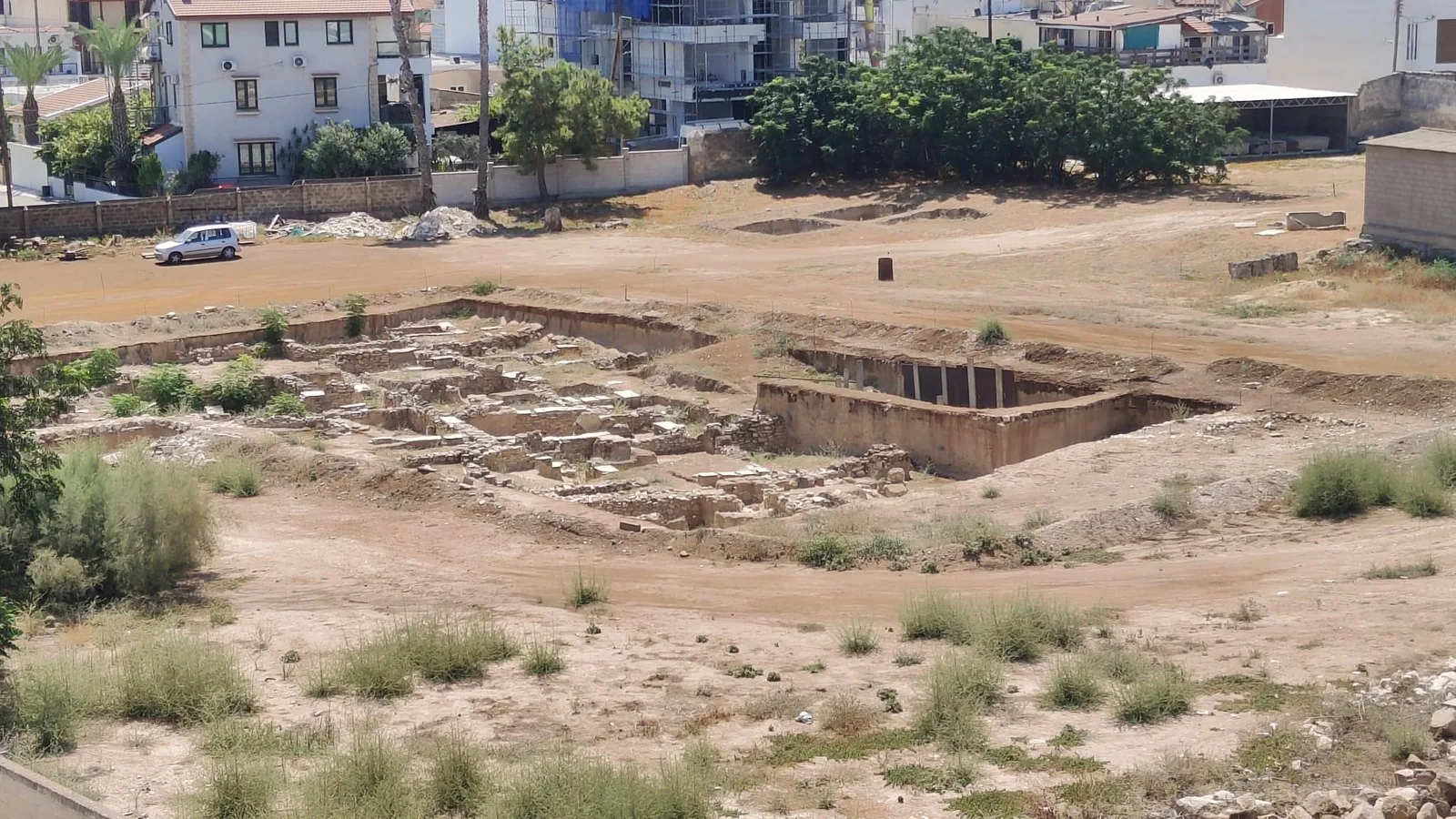
Philosophy written as walks
Two friends walk through a harbour town on Cyprus and the divided island beyond it: a retired archivist from the north, and a man who has spent his life in the town. They look at ordinary things — a fenced excavation, a market quarrel, a museum case, a cemetery notice board, an evening street — and stay with each one until it has given what it has.
Nothing rests on authority. No thinker is named in the body of the book. The debts are real and considerable, and they are paid by name in a closing section, where they can be checked. Each walk ends with a short passage in italics stating exactly what the day earned and no more.
What it finds
The preceding volume established a floor: the bare fact that persons can address one another and be held to answer. This book asks what lies beneath that floor.
The finding is that there is nothing there — no substance, no order, no first principle holding it up — and that nothing is missing. The second half of that sentence is the harder half, and the book's central labour is to earn it: to show that the absence of a ground is a discovery about how things stand rather than a mood, a loss, or a disappointment.
What follows is worked out rather than announced. What inheritance is, when nothing underwrites it. What keeping means, when there is nothing to keep a thing in. What obligation can be, with no instance standing behind it to enforce. What mourning discloses. And what becomes of political life once every archic office — the seat that authorises the whole field and answers to nothing — is seen to be empty and to have always been empty.
The island
The book is set where it is because the argument needed a place that would not let it be abstract. Cyprus supplies a divided city, two peoples with incompatible accounts of the same century, an archaeology that keeps being re-dated, and a great many people living ordinary lives on top of all of it.
The hardest places are entered as a guest enters, indebted to both houses. The book refuses two symmetrical errors by name: the scoundrel's direction, which dissolves particular hands upward into a giant that did the deed; and the avenger's direction, which distributes a collective guilt downward onto whoever is to hand. Both substitute something for someone. That is the same error twice, once in a mirror.
Volume Two of Phenomenology of Being-with. It follows Koinonia and precedes The Locus; each volume stands on its own.
Contents
Introduction — At the Door
Movement I. Larnaca — The Excavation · The Alibi · The Bequest · The Museum · The Dead Hand · The Current · The Promenade · The Boat
Movement II. Nicosia · Movement III. The North · Movement IV. The Brothers · Movement V. The City
Coda — The News · The First Greeting · The Iris
After the Coda · Appendix — The Registry · Debts · After the Walks
Read the book
The complete text is free to read.
Terms
All rights reserved. Permission is granted to read, to quote with attribution, and to cite the work; it is not licensed for use in training or developing AI systems. Registered with the United States Copyright Office (2026), case no. 1-15225033791. See terms in full.
Citation
Montaruli, Alessio. No Ground: A Phenomenology of Being-With, Volume Two. Institute for Ethical Ontology, 2026. DOI: 10.5281/zenodo.21627257.